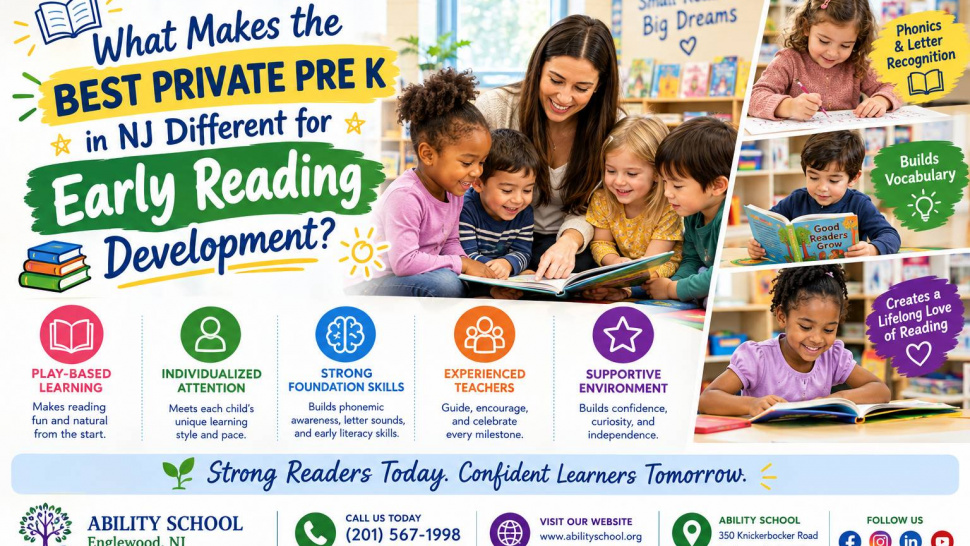

What actually separates a strong preschool reading program from one that only looks impressive on paper? Parents comparing the best private pre k in NJ usually want more than alphabet practice and colorful reading corners.
They want to know whether their child is learning to understand words, follow ideas, build vocabulary, and enjoy using language. The New Jersey preschool age range includes children at very different stages, so reading instruction cannot depend on one pace for an entire class.
Why Early Reading Development Starts Before a Child Reads Alone
Reading begins long before a child can finish a page without help. Listening, speaking, recognizing sounds, remembering sequences, asking questions, and connecting words with meaning all come first.
That is why parents looking at the best private pre k in NJ should examine what happens before formal reading begins. A child within the New Jersey preschool age range may know most letter sounds but still struggle to explain a story. Another child may speak with a large vocabulary but need more practice matching sounds with print.
Those differences are normal. A strong preschool program notices them early and adjusts instruction. It does not assume that every four-year-old should complete the same reading task on the same day.
Ability School uses an individualized approach that allows children to spend more time on skills they have not mastered while moving ahead when they are ready. That approach gives early reading instruction more room to respond to the learner rather than the schedule.
The result is not faster reading for the sake of speed. The goal is stronger comprehension and better control over the basics.
How Individual Learning Pace Changes Reading Readiness
Many reading difficulties in preschool start when instruction moves ahead before the earlier skill feels secure. A child may memorize a few words and appear advanced, yet still have trouble sounding out unfamiliar ones. Another may recognize letters but lose the meaning of a sentence while concentrating on each sound.
Parents comparing the best private pre k in NJ should ask how teachers respond when a child understands one reading skill but needs support with another. The New Jersey preschool age group covers a wide developmental span, so teachers need room to adjust without treating the child as behind.
Individual pacing can help in several ways. A teacher can slow down phonics work, spend longer on vocabulary, repeat story sequencing, or introduce more challenging material when the child shows clear readiness.
That sounds simple, but it changes the classroom experience. Children are less likely to repeat work they already know, and they are less likely to move forward with gaps that later become harder to correct.
This is where mastery becomes useful. Progress should come from what the child can apply, not from how many worksheets have been completed.
What Parents Should Look For in a Mastery-Based Reading Program
The phrase “early literacy” appears on many preschool websites. Parents still need to know what the school means by it.
When families compare the best private pre k in NJ, they can look beyond broad promises and ask how teachers check whether a child can actually use a skill. For children in the New Jersey preschool age range, a well-developed literacy program may include:
Recognizing and producing common letter sounds
Retelling a short story in the correct order
Using new words during normal conversation
Connecting printed letters with spoken sounds
Answering simple questions about a story
Applying a familiar reading skill to a new word or example
These tasks reveal much more than simple recall. They show whether the child can carry a skill from one activity into another.
That transfer is important. Reading does not happen as a set of isolated exercises. Children must combine sound recognition, memory, vocabulary, context, and comprehension at the same time.
Why Practical Learning Supports Stronger Language Skills
Children often remember language better when they connect it with something they have done, seen, built, discussed, or explored. That is one reason the best private pre k in NJ should not separate literacy from the rest of the school day. The New Jersey preschool age years give teachers many opportunities to build language through practical experiences.
A science activity can introduce new descriptive words. A classroom project can strengthen sequencing. A story discussion can improve recall and interpretation. Even a simple task that asks a child to explain what happened first, next, and last supports later reading comprehension.
Ability School includes hands-on learning within its wider educational approach. That gives children repeated chances to use language in context instead of treating reading as a stand-alone exercise.
This type of learning also helps teachers see whether a child understands a word or has only memorized it. A child who can explain, demonstrate, or apply an idea usually shows a stronger level of learning.
Conclusion
Parents searching for the best private pre k in NJ should look closely at how a school teaches reading, not only at how early it introduces books or phonics. The New Jersey preschool age years involve wide differences in language, attention, comprehension, and academic readiness. A program that uses individual pacing, checks for real mastery, connects reading with practical learning, and allows children to progress when they are prepared can build a more reliable early literacy foundation.


Share the News