

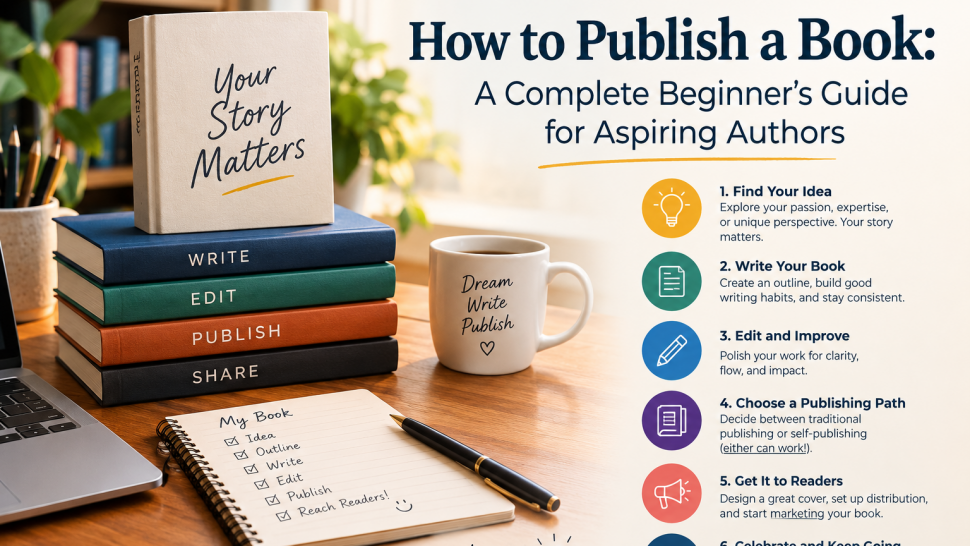

Finishing a manuscript is a significant achievement, but the journey from a completed draft to a published book involves several additional stages. A manuscript still needs editorial review, professional formatting, a suitable cover, publishing decisions, and careful quality control before readers can experience the finished work.
For first-time authors, the process can seem complicated because writing and publishing require different skills. Knowing how to move from manuscript to book makes the process more manageable and helps authors avoid expensive or frustrating mistakes.
Whether you have written a novel, memoir, business book, professional guide, or nonfiction resource, this guide explains the major stages involved in transforming your manuscript into a publication-ready book.
What Is the Process From Manuscript to Book?
A manuscript is the written content of a book before it has gone through the complete publishing and production process. It may contain the chapters and other material, but it is not necessarily ready to be printed, distributed, or sold.
Turning a manuscript into a finished book generally involves:
Completing and revising the manuscript
Editing and proofreading
Preparing the book's structure and front matter
Designing the cover
Formatting the interior
Choosing publishing and distribution options
Preparing metadata and publishing information
Reviewing a proof
Finalizing the book for release
Developing a marketing and distribution plan
The exact order can vary depending on the publishing model and type of book, but the principle is consistent: production should begin only after the content is sufficiently stable.
Step 1: Finish and Revise the Manuscript
The first requirement is a complete manuscript.
This does not mean the manuscript has to be perfect. It means the author should have a complete version that can be evaluated as a whole.
Start with a broad revision rather than correcting every comma immediately. Look at the structure and ask whether the book accomplishes what it intends to accomplish.
For Fiction
Consider:
Plot structure
Character development
Pacing
Dialogue
Continuity
Point of view
Ending
For Nonfiction
Consider:
Organization
Accuracy
Chapter progression
Supporting evidence
Repetition
Examples
Practical usefulness
For example, an entrepreneur writing a business book may discover during revision that three chapters explain essentially the same concept. Combining them could make the book more concise and improve the reader's experience.
Step 2: Define the Intended Reader
Before moving into professional production, identify who the book is actually for.
This decision influences many later stages, including editing, cover design, title development, pricing, distribution, and marketing.
Instead of saying your book is “for everyone,” describe the most relevant reader specifically.
For example:
“This book is for first-time entrepreneurs who want practical guidance on building a small service business.”
That statement gives an editor, designer, and marketer useful context.
It also helps the author evaluate whether individual sections belong in the final book.
Step 3: Get the Manuscript Professionally Edited
Editing is one of the most important stages in moving from manuscript to book.
Authors are often too close to their own writing to identify every weakness. A professional editor can provide an independent perspective and identify problems that automated writing tools cannot reliably detect.
Developmental Editing
Developmental editing focuses on the larger structure of the book. It may address organization, pacing, chapter order, arguments, character development, and overall coherence.
Copyediting
Copyediting works at the sentence and paragraph level. It can address grammar, punctuation, spelling, word choice, consistency, and style.
Proofreading
Proofreading is generally performed after substantive editing and formatting. It is the final search for errors that remain in the publication-ready material.
Not every book requires the same amount of editorial work. The right level depends on the manuscript's condition, genre, complexity, and intended audience.
Step 4: Organize the Book's Front and Back Matter
A published book contains more than the main chapters.
Depending on the project, front matter may include:
Title page
Copyright page
Dedication
Table of contents
Foreword
Preface
Introduction
Back matter may include:
Acknowledgments
Author biography
References
Bibliography
Discussion questions
Additional resources
Index
Not every book needs all of these elements. The goal is to determine which components genuinely serve the reader and then organize them correctly.
Step 5: Create a Professional Cover
Once the manuscript is approaching its final form, cover design becomes an important part of the publishing process.
The cover should communicate the book's subject or genre and make the title and author name easy to recognize. It also needs to work across the formats in which the book will appear.
A paperback cover, for example, may include a front cover, spine, and back cover, while an ebook cover is typically presented as a single digital image.
A Useful Cover Test
Look at your proposed cover at a small size, similar to how it might appear in an online bookstore.
Can you quickly identify:
The title?
The author's name?
The general genre or subject?
The overall tone of the book?
If those elements disappear when the cover is reduced, the design may need refinement.
Step 6: Format the Interior
Formatting transforms the edited manuscript into a readable book layout.
For print, this can include page dimensions, margins, typography, chapter openings, page numbers, headers, footers, images, tables, and other layout elements.
Ebooks require different formatting because the text needs to adapt to different screen sizes and reader settings.
This is why simply exporting a word-processing document is not always sufficient. The final files should be prepared specifically for their intended format.
Authors should also check special content carefully. Tables, charts, photographs, footnotes, poetry, lists, and unusual typography may require additional formatting attention.
Step 7: Choose Your Publishing Route
At this stage, authors should have a clear understanding of how they want to publish.
Traditional Publishing
A traditional publisher typically acquires publishing rights through an agreement with the author and takes responsibility for many aspects of production and distribution.
This route can offer professional support but generally involves less author control over certain publishing decisions.
Self-Publishing
With self-publishing, the author retains much greater control and takes responsibility for arranging the necessary services.
The author can work independently or hire specialists for editing, design, formatting, distribution, and marketing.
Professional Publishing Assistance
There is also a middle ground in which authors retain substantial control while obtaining help with selected publishing tasks. For authors who want structured assistance during the transition from manuscript to book, professional publishing services may be one option to evaluate.
Regardless of the model, understand exactly who owns the rights, who controls the files, what services are included, and how payments or royalties are handled.
Step 8: Prepare Publishing Information
Before publication, make sure the book's administrative information is accurate.
Depending on the publishing route and format, this may involve:
ISBN information
Copyright information
Author name
Publisher information
Edition details
Book description
Categories or subject information
Keywords or metadata
Pricing
Distribution selections
ISBN and copyright are different things, so authors should not treat them as interchangeable. For legal or registration questions, consult current information from the relevant official authority for your jurisdiction.
Careful preparation at this stage prevents incorrect information from appearing in retail listings or inside the finished book.
Step 9: Review a Proof Before Release
Never assume that a final file is automatically perfect.
If a print edition is being produced, review a physical proof when the publishing process provides one. Read through the book and inspect both the text and the physical presentation.
Check for:
Incorrect page breaks
Missing text
Duplicate pages
Formatting inconsistencies
Image problems
Incorrect page numbers
Cover alignment
Unexpected blank pages
Table of contents errors
For ebooks, review the file on appropriate devices or preview tools to identify layout and navigation problems.
The proofing stage is quality control, not a formality.
Step 10: Create a Plan for Reaching Readers
Once the book is technically ready, the next challenge is helping the intended audience discover it.
A marketing plan might include:
Author website
Email communication
Social media
Interviews
Podcasts
Book events
Speaking engagements
Professional networks
Community organizations
Reader communities
The best approach depends on the book.
A business author may find professional events and industry connections useful, while a novelist may focus more on genre communities, reader groups, reviews, and author events.
Do not wait until the day of publication to think about audience development. Preparation can begin well before launch.
Common Mistakes When Turning a Manuscript Into a Book
Making Major Changes After Formatting
If chapters are still being rewritten after formatting, production work may need to be repeated. Complete substantial revisions before final layout whenever possible.
Assuming Proofreading Replaces Editing
Proofreading catches remaining errors; it does not normally solve structural or developmental problems. Make sure the manuscript receives the appropriate type of editorial review.
Choosing a Cover Based Only on Personal Preference
The author's opinion matters, but the cover also needs to communicate with the intended reader. Research comparable books and consider how your design fits the expectations of your genre or category.
Ignoring Rights and Contracts
If another company or professional is involved, understand the agreement before signing it. Pay attention to rights, ownership, fees, royalties, deliverables, and termination terms.
Treating Marketing as an Afterthought
A professionally produced book still needs a way to reach readers. Define your audience and promotional strategy before publication rather than assuming the book will discover its audience automatically.
Practical Tips for First-Time Authors
A few simple habits can make the transition smoother:
Keep a master manuscript.
Maintain one clearly identified version of the approved text and organize older drafts separately.
Use consistent terminology.
Create a basic style sheet for names, capitalization, spelling, technical terms, and recurring details.
Separate editorial and design decisions.
Finish major content changes before spending significant time on final layout.
Ask for written specifications.
When working with a publisher, editor, designer, or formatter, make sure you understand what files and services are included.
Keep copies of your final files.
Retain editable source files and final publication files when they are provided.
Review everything before approval.
The author should carefully inspect the final product even when professionals have handled production.
Turning a Manuscript Into a Book in Miami and South Florida
Authors in Miami and South Florida have access to a diverse network of entrepreneurs, professionals, artists, educators, community organizations, bookstores, libraries, and cultural events.
This can be particularly valuable for books with regional relevance. A memoir about Miami, a business book aimed at South Florida entrepreneurs, or a novel set in the region may have opportunities for local events and community connections.
However, local promotion should not automatically define the entire publishing strategy. A Florida-based author can have a national or international readership, particularly when the book addresses a subject with broader relevance.
If your manuscript includes Miami or South Florida locations, organizations, historical events, or businesses, verify those details carefully. Regional accuracy can strengthen the credibility of the finished book.
Frequently Asked Questions
How long does it take to turn a manuscript into a book?
There is no single timeline because every manuscript is different. The process can involve revision, developmental editing, copyediting, proofreading, cover design, formatting, proofing, distribution setup, and marketing preparation. A manuscript requiring substantial structural work will naturally take longer than one that is already polished and publication-ready.
Can I turn my manuscript into a book without a publisher?
Yes. Authors can self-publish and manage the process independently or hire individual professionals for specific services. The author remains responsible for coordinating editing, design, formatting, distribution, and marketing unless those responsibilities are delegated to a publishing service provider.
Should my manuscript be completely edited before formatting?
Major editorial work should generally be completed before final formatting. Substantial changes made after layout can require pages, chapter breaks, tables of contents, and other elements to be reformatted. A final proofreading pass can then be performed after the book has been formatted.
What is the difference between a manuscript and a published book?
A manuscript is the written work before it has completed the publishing and production process. A published book includes the finished editorial work, cover, interior design, publishing information, and production files required for its selected format and distribution channels.
Do I need professional help to publish my first book?
Not necessarily, but professional assistance can be useful when you lack experience in a particular area. Authors may choose to handle some tasks themselves and hire specialists for editing, cover design, formatting, or other stages. The right balance depends on the author's skills, budget, schedule, and quality expectations.
What should I do immediately after finishing my manuscript?
Start with a complete revision rather than immediately formatting the book. Evaluate the structure, intended audience, consistency, and overall quality. Once the manuscript is stable, determine what editorial and production services it needs and choose a publishing route that matches your goals.
Conclusion
Moving from manuscript to book is a process of refinement. The writing provides the foundation, but editing, design, formatting, publishing decisions, proofing, and reader outreach turn that foundation into a finished publication.
First-time authors should resist the urge to rush the final stages. Complete the manuscript, revise it carefully, define your audience, obtain appropriate professional support, prepare the book for its intended format, review the proof, and understand the publishing agreement before approving the final release.
A thoughtful approach makes each stage easier to manage and gives the finished book a stronger professional foundation. Whether you are publishing from Miami, elsewhere in Florida, or reaching readers around the world, careful preparation can help your manuscript make the transition into a book with clarity and confidence.



Share the News