

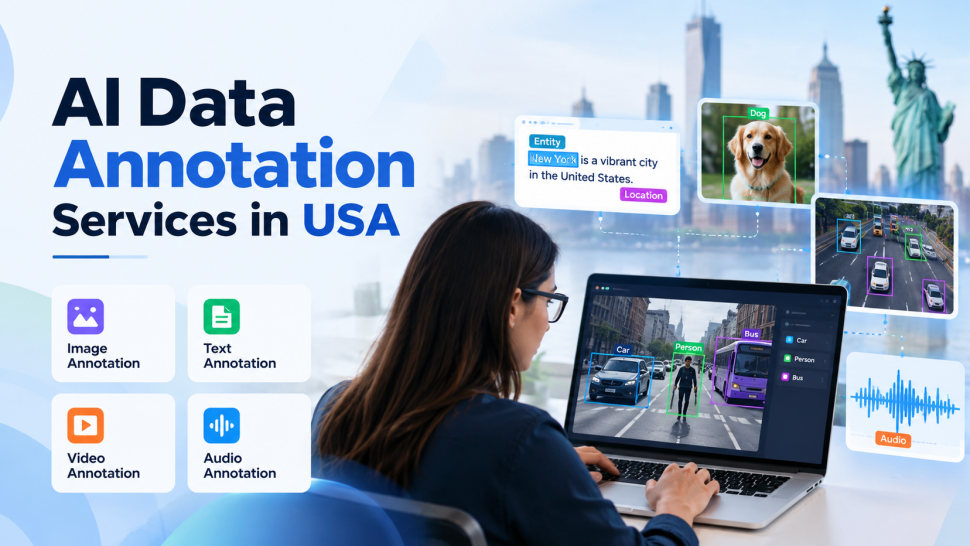

Artificial intelligence is changing how businesses operate, make decisions, and serve their customers. From healthcare and manufacturing to retail, transportation, and finance, companies are using AI to automate tasks, recognize patterns, and solve problems faster. However, AI systems cannot deliver reliable results without accurate, well-organized training data. This is where AI Data Annotation Services in USA play an important role.
Data annotation involves labeling images, videos, text, audio, and other types of information so AI models can understand and process them correctly. For example, a healthcare AI model may need labeled medical images to identify abnormalities, while a self-driving vehicle system needs annotated road images to recognize pedestrians, traffic signs, and nearby vehicles.
Businesses across different industries have different data requirements. Some need precise image labeling, while others require video tracking, text classification, or sentiment analysis. Choosing the right annotation approach helps improve model accuracy, reduce data errors, and support practical AI applications.
At Vision Infotech, we understand the importance of high-quality data in AI development. By focusing on data quality, project requirements, and industry-specific needs, businesses can prepare datasets that support more dependable AI solutions.
In this blog, we will explore how AI data annotation is used across different industries, the annotation methods involved, and what businesses should consider when selecting a service provider.
What Are AI Data Annotation Services in USA?
AI data annotation is the process of adding meaningful labels to raw data so machine learning models can learn from it. Raw data may include photographs, recorded videos, customer conversations, documents, medical scans, or sensor readings. Without appropriate labels, many supervised machine learning models cannot reliably identify the patterns they are designed to learn.
For example, an image recognition model designed to identify fruits needs images labeled as apples, bananas, oranges, and other relevant categories. A more advanced model may need bounding boxes around each fruit or pixel-level labels that identify its exact shape.
Professional AI Data Annotation Services can support several types of labeling based on the project's objectives.
Common Types of Data Annotation
- Image annotation: Identifying and labeling objects, people, products, or features within images.
- Video annotation: Labeling objects and activities across video frames to help models understand movement and events.
- Text annotation: Categorizing written content, identifying entities, and labeling customer sentiment or intent.
- Audio annotation: Transcribing speech, identifying speakers, and labeling relevant sounds.
- Sensor data annotation: Labeling information from devices such as LiDAR sensors, radar systems, and other connected equipment.
The right annotation method depends on the AI model, the type of data being collected, and the result the business wants to achieve.
1. Healthcare: Supporting Medical Image Analysis
Healthcare is one of the most important industries where annotated data can support AI development. Hospitals, medical technology companies, and healthcare researchers are exploring AI tools for medical image analysis, patient monitoring, and clinical workflow support.
These applications often require carefully labeled datasets because errors in medical data can affect model performance and clinical decision-making.
How Annotation Is Used in Healthcare
AI developers may use annotated X-rays, CT scans, MRI images, and other medical images to train models to identify specific anatomical structures or potential abnormalities.
For example, a research team developing an AI system to assist with lung image analysis may require qualified medical professionals to identify relevant regions in a collection of scans. Annotators can then apply the agreed labeling guidelines to prepare the dataset for model training.
Healthcare annotation can include:
- Identifying regions of interest in medical images.
- Drawing bounding boxes around specific anatomical structures.
- Creating segmentation masks for organs or lesions.
- Labeling medical documents and clinical text.
- Organizing data for medical research applications.
Why Data Quality Matters
Medical datasets require strict quality checks, clear labeling guidelines, and appropriate privacy safeguards. Depending on the project, domain experts may need to review annotations before the data is used for training.
Annotation does not independently establish a medical diagnosis or prove that an AI system is clinically reliable. Models must undergo suitable testing and validation before being used in real healthcare environments.
2. Automotive: Improving Driver Assistance and Autonomous Systems
The automotive industry depends on AI to interpret road conditions, recognize objects, and support advanced driver-assistance systems. Autonomous driving research also relies on large amounts of annotated visual and sensor data.
Vehicles encounter changing road conditions, pedestrians, cyclists, traffic signals, construction zones, and unexpected obstacles. AI models must learn to recognize these elements under different circumstances.
The Role of Image and Video Annotation
AI developers use annotated road images and video recordings to teach models how to identify important objects.
For example, a dataset collected from a vehicle camera may contain cars, pedestrians, road signs, traffic lights, and lane markings. Annotators label these objects so developers can train and evaluate object detection and tracking models.
Common annotation tasks include:
- Drawing bounding boxes around vehicles and pedestrians.
- Marking lane boundaries and road markings.
- Tracking objects across consecutive video frames.
- Labeling traffic signs and signals.
- Annotating LiDAR point clouds for three-dimensional object detection.
AI Video Annotation Services in USA can be useful for projects that need consistent labels across long video sequences. Tracking the same vehicle across multiple frames helps create training data for understanding movement rather than simply identifying objects in individual images.
Annotation quality is especially important when the dataset includes night driving, poor weather, unusual road layouts, or partially hidden objects.
3. Retail and E-commerce: Better Product Recognition and Customer Insights
Retailers and e-commerce companies use AI to improve product discovery, manage inventory, personalize shopping experiences, and understand customer behavior.
These applications depend on organized product information, labeled images, and sometimes annotated customer feedback.
Product Recognition and Visual Search
Imagine an online store that wants customers to find a product by uploading a photograph. The AI system needs training data that helps it recognize product categories, shapes, colors, and relevant visual features.
AI Image Annotation Services in USA can help prepare product images by labeling objects, identifying product attributes, and categorizing items.
Retail annotation tasks may include:
- Identifying products in catalog images.
- Labeling product categories and attributes.
- Marking objects in shelf images for inventory analysis.
- Classifying customer reviews by sentiment or topic.
- Organizing product images for visual search systems.
Example: Automated Shelf Monitoring
A retailer may use camera images to identify empty shelves or products placed in the wrong location. Annotated shelf images help train models to distinguish between product types and recognize gaps in inventory displays.
Retail businesses can also use text annotation to categorize customer feedback. For instance, reviews mentioning delivery delays, damaged packaging, or product quality can be grouped to help teams understand recurring issues.
The result depends on factors such as image quality, product similarity, annotation consistency, and the representativeness of the training data.
4. Manufacturing: Detecting Defects and Improving Quality Control
Manufacturers need consistent product quality while managing production costs and minimizing waste. AI-powered visual inspection can help identify defects that might be difficult to detect consistently through manual inspection alone.
However, an inspection model needs examples of both acceptable products and different types of defects.
How Data Annotation Supports Manufacturing
Annotators label images of manufactured components, materials, and finished products to help AI models distinguish normal variations from potential problems.
Typical applications include:
- Identifying scratches, cracks, and surface damage.
- Labeling missing or incorrectly positioned components.
- Detecting irregularities in product dimensions or shapes.
- Classifying acceptable and defective products.
- Annotating production-line videos for process monitoring.
Example: Electronics Inspection
An electronics manufacturer may want to detect damaged circuit boards before products leave the factory. Annotators can label images of circuit boards, marking damaged connections, missing components, or visible defects.
The annotated dataset can then be used to train and evaluate a visual inspection model.
For manufacturing projects, consistent labeling rules are essential. If different annotators classify the same defect differently, the model may learn inconsistent patterns. Quality checks and review procedures help reduce these problems.
5. Banking and Finance: Supporting Document Processing and Fraud Detection
Financial institutions process invoices, receipts, bank statements, loan applications, identity documents, and other records. AI can help extract information from these documents, classify transactions, and identify patterns that deserve further review.
Data annotation helps prepare the examples needed to train such systems.
Common Financial Annotation Applications
Document processing: Annotators label fields such as invoice numbers, dates, account references, totals, and tax amounts. These labels can help train document understanding and information extraction systems.
Transaction classification: Financial records may be categorized by transaction type, purpose, or other relevant attributes.
Fraud-related analysis: Historical examples may be labeled according to established review outcomes to help develop models that identify suspicious patterns.
Customer support: Financial conversations and messages can be classified by intent, topic, or urgency.
For example, an invoice-processing solution may need to recognize the supplier name, invoice date, subtotal, tax, and total amount across documents with different layouts. Annotated examples can help the model learn where these fields appear.
Financial data requires careful handling. Businesses should establish access controls, protect personal and financial information, and verify that annotation providers follow appropriate security and confidentiality requirements.
Annotation alone cannot guarantee fraud detection or eliminate false positives. Models need suitable testing, monitoring, and human review.
6. Agriculture: Supporting Crop Monitoring and Precision Farming
Agriculture is increasingly using computer vision, drones, satellite imagery, and connected sensors to monitor crops and support farm management.
AI models can analyze these sources to help identify crop stress, estimate plant growth, recognize weeds, and monitor field conditions. Annotated agricultural data provides examples that help these models distinguish between different plants, conditions, and objects.
Where Annotation Makes a Difference
Agricultural annotation projects may involve:
- Labeling healthy and damaged plants.
- Identifying weeds in crop fields.
- Marking visible signs of pest damage.
- Annotating aerial images of farmland.
- Classifying crop growth stages.
- Identifying fruits or vegetables for automated harvesting research.
Example: Weed Identification
A developer building a precision-spraying system may need a model that distinguishes weeds from crops. Annotators label images containing different plant species, lighting conditions, soil types, and growth stages.
The dataset should include difficult examples, such as weeds growing close to crops or plants partly hidden by leaves. This helps developers evaluate how well the model handles real field conditions.
Agricultural data varies with season, geography, weather, and crop type. A dataset collected from one farm may not represent conditions elsewhere, so broader and more diverse examples can be valuable.
7. Logistics and Transportation: Improving Object Tracking and Operations
Logistics companies handle large volumes of parcels, warehouse inventory, delivery vehicles, and transportation records. AI can support package identification, automated sorting, route-related analysis, and warehouse monitoring.
These systems often rely on annotated images, videos, and documents.
Common Use Cases
- Identifying packages on conveyor belts.
- Reading and classifying shipping labels.
- Detecting damaged parcels.
- Tracking vehicles and objects in video.
- Recognizing warehouse items and storage locations.
- Extracting information from shipping documents.
For example, a parcel sorting facility may use cameras to identify packages moving along a conveyor. Annotated images can help a model distinguish packages by shape, label location, and other visible characteristics.
Video annotation is particularly useful when a project needs to track a parcel or vehicle across multiple frames. Consistent object IDs and timestamps can help preserve continuity throughout the recording.
Businesses should also consider camera placement, motion blur, lighting, and package overlap when preparing the training dataset.
8. Real Estate and Construction: Analyzing Properties and Building Sites
Real estate and construction companies can use AI to analyze property photographs, inspect building sites, monitor progress, and organize project documentation.
These applications require datasets that represent different property types, building materials, site conditions, and stages of construction.
Practical Applications of Annotation
- Identifying rooms, doors, windows, and other property features.
- Categorizing property images by room type.
- Detecting visible cracks or surface damage.
- Identifying construction equipment and workers in site images.
- Tracking visible changes across construction videos.
- Labeling aerial images for site analysis.
For example, a property platform may use annotated photographs to identify kitchens, bedrooms, bathrooms, and outdoor spaces. This can support automatic photo categorization and improve property search filters.
In construction, a project team may use annotated site images to train a model to identify certain visible safety risks or track equipment. Any safety-related system needs careful validation because camera footage may not capture every hazard.
Clear annotation guidelines and realistic datasets help ensure that the resulting model is evaluated against the conditions it will encounter.
9. Education and Customer Service: Understanding Text, Speech, and User Intent
AI is also being used in online learning platforms, customer support systems, and conversational applications. These systems may need to understand written questions, spoken requests, feedback, and the context behind a conversation.
Text and audio annotation help prepare datasets for these purposes.
Examples of Annotation in These Industries
Education: Questions may be categorized by subject, difficulty, or learning objective. Educational speech data can be transcribed to support speech-based learning tools.
Customer service: Support conversations can be labeled by customer intent, issue type, sentiment, or resolution status.
Conversational AI: Example dialogues can be annotated to distinguish questions, instructions, follow-up requests, and other conversation elements.
For instance, a company developing a customer support assistant may classify thousands of past messages into categories such as billing, account access, technical problems, and product information. This helps developers train and evaluate a model that routes requests to the right team.
Annotation guidelines should address ambiguous language, spelling errors, regional expressions, and differences in how customers describe the same issue. Audio and text datasets should also be handled in accordance with relevant privacy requirements.
What Should Businesses Consider When Choosing an Annotation Provider?
Selecting a provider involves more than comparing prices or the number of records that can be labeled each day. The provider should understand the project's requirements and have a process for maintaining consistent data quality.
When evaluating AI Data Annotation Services in USA, businesses should consider the following factors.
1. Industry and Project Understanding
Choose a team that can understand the type of data being annotated and the intended AI application. Medical image segmentation, retail product labeling, and autonomous vehicle annotation require different skills and workflows.
2. Clear Annotation Guidelines
Before large-scale annotation begins, establish labeling definitions, examples, edge cases, and instructions for uncertain records. A small pilot project can reveal gaps in these guidelines.
3. Quality Assurance
Ask how the provider checks completed work. Useful measures may include sample reviews, agreement checks between annotators, error tracking, and expert validation where required.
4. Data Security and Confidentiality
Review access controls, confidentiality agreements, data retention policies, and the handling of sensitive information. Confirm that the proposed process fits your legal and contractual obligations.
5. Scalability and Delivery
Determine whether the provider can handle the expected data volume, follow agreed deadlines, and maintain consistent labeling standards as the project grows.
6. Transparent Communication
A reliable provider should explain project assumptions, report issues, and discuss changes when data quality or requirements differ from the original plan.
These checks help businesses assess whether an annotation partner is suitable for their needs.
Why Choose Vision Infotech for AI Data Annotation?
Vision Infotech works with businesses seeking practical technology solutions, including AI development and related data services. For organizations preparing training datasets, a clear understanding of the intended AI application is an important starting point.
Here is what businesses should look for when considering Vision Infotech for an annotation project.
A Business-Focused Approach
Every AI project has a different goal. A retail company may need product recognition, while a manufacturer may need defect detection. Defining the desired outcome first helps establish appropriate labeling categories and quality requirements.
Support for Different Data Requirements
Depending on the agreed project scope, annotation work may involve image labeling, video analysis, text categorization, or other data preparation tasks. The required formats and methods should be confirmed before work begins.
Emphasis on Data Quality
Consistent labels, documented instructions, and appropriate quality checks help prepare more useful training datasets. Vision Infotech can discuss project-specific requirements and the validation steps needed for the intended application.
Alignment With AI Development Goals
Annotation is most useful when it supports a defined model-training or evaluation objective. Businesses should explain their use case, available data, target outputs, and performance requirements so the project can be planned accordingly.
Clear Project Scope and Communication
Before starting, discuss expected data volumes, annotation complexity, timelines, review requirements, security expectations, and deliverables. These details help both teams establish realistic expectations.
If you are considering AI Data Annotation Services in USA, contact Vision Infotech to discuss your use case and determine the appropriate scope for your project. The final approach should be based on your data, business objectives, and quality requirements rather than a one-size-fits-all process.
Conclusion
AI data annotation supports a wide range of industries, including healthcare, automotive, retail, manufacturing, finance, agriculture, logistics, real estate, and education. Each industry uses labeled data differently, but the underlying goal remains similar: helping AI models learn from relevant examples and perform their intended tasks more reliably.
High-quality annotation starts with clear project requirements, suitable labeling methods, consistent guidelines, and effective quality checks. Businesses must also consider data privacy, real-world conditions, and model validation when preparing datasets for production use.
AI Data Annotation Services in USA can help organizations prepare the structured data needed for computer vision, natural language processing, document understanding, and other AI applications. The value comes not simply from labeling large amounts of data, but from producing accurate, relevant, and well-validated datasets.
Vision Infotech can help businesses explore data preparation requirements as part of their broader AI development goals. By defining the use case and quality expectations early, organizations can make more informed decisions about their annotation projects and build a stronger foundation for AI development.



Share the News