

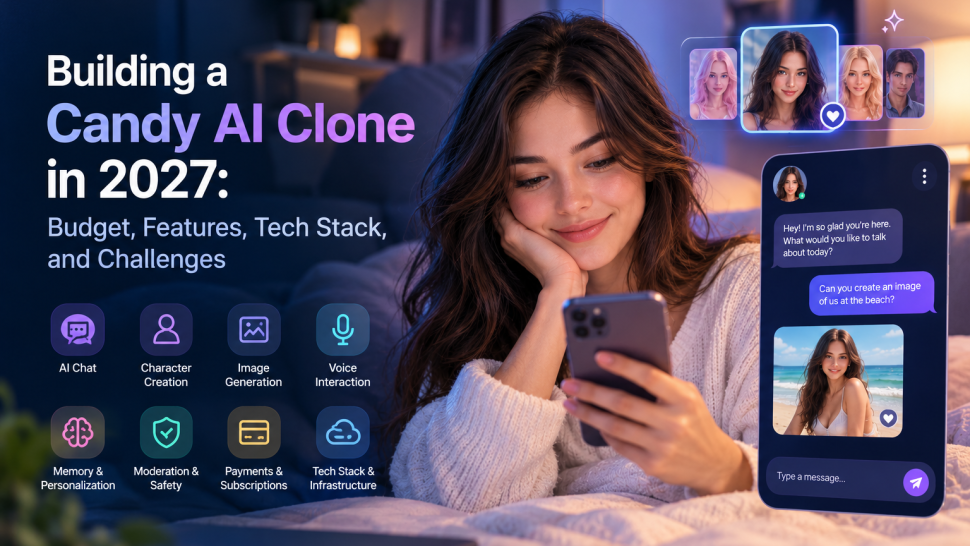

AI companion platforms have moved beyond simple text conversations. Users increasingly expect an experience that can combine natural conversation with character customization, memory, voice, images, and other interactive features.
That makes building a Candy AI clone less about copying a visual interface and more about understanding the technology and product decisions underneath it.
Candy AI itself positions its experience around personalized AI companions, custom characters, conversation, memory, voice, and visual interactions.
For founders considering a similar product in 2027, four questions usually come first: What should the platform include? How much will it cost? Which technologies should power it? And what problems could make development more complicated than expected?
This guide looks at those questions from a practical product-development perspective.
What Is a Candy AI Clone?
A Candy AI clone is a custom AI companion platform inspired by the functionality and user experience of Candy AI.
The word *clone* does not necessarily mean reproducing another product pixel-for-pixel. A more sensible approach is to identify the capabilities that make the concept attractive and build an original product around them.
A typical platform could allow users to:
- Create or select AI characters
- Define personality and appearance
- Have real-time AI conversations
- Maintain conversation history
- Store relevant user preferences
- Generate images
- Interact through voice
- Create roleplay or story experiences
- Purchase subscriptions or credits
- Manage their account and privacy settings
The exact feature set depends on the audience and business model.
A founder building an MVP does not necessarily need every feature on day one. Starting with strong conversation and character experiences can be more practical than immediately investing in expensive video generation, complex avatars, and numerous integrations.
Core Features an AI Companion Platform Needs
The most important features are not necessarily the ones that look impressive in a product demo. They are the ones that make users want to return.
1. AI Character Creation
Character creation is one of the foundations of an **AI companion** platform.
Users can potentially define attributes such as:
- Name
- Appearance
- Personality
- Interests
- Background
- Communication style
- Relationship type
- Voice
The backend then needs to translate those choices into consistent instructions and context for the AI.
A character should not suddenly behave completely differently simply because the conversation has become longer.
2. Conversational AI
Text conversation remains the central experience.
The platform needs an LLM capable of producing natural responses while following the character's defined personality and the platform's safety rules.
But simply connecting an application to an LLM API is not enough.
The product also needs to manage:
- Conversation context
- Prompt construction
- Token usage
- Response latency
- Error handling
- Usage limits
- Model selection
- Content filtering
The model is only one component of the overall system.
3. Memory and Context
Memory can make a major difference to an AI companion experience.
Instead of treating every conversation as a fresh interaction, the platform can store useful information such as preferences, recurring topics, character relationships, or important details from previous conversations.
A practical architecture might divide information into:
**Short-term context:** What is happening in the current conversation.
**Conversation history:** Previous messages that may be relevant.
**Long-term memory:** Selected facts or preferences worth retaining.
This needs careful design. Saving everything is not automatically better. Irrelevant or incorrect memories can make an AI companion feel less believable rather than more intelligent.
4. Image Generation
Visual generation can extend the experience beyond text.
Depending on the product, users might generate:
- Character portraits
- Different outfits
- Different environments
- Scene-based images
- Personalized visual content
The technical challenge is consistency.
If a user creates a character with specific visual characteristics, those characteristics should remain reasonably consistent across generations.
That can require carefully designed prompts, reference images, model selection, image workflows, and potentially fine-tuning or adapters.
5. Voice Interaction
Voice can make an AI companion feel considerably more interactive.
A typical voice pipeline includes:
User speech → speech-to-text → language model → text response → text-to-speech → audio
Each additional stage introduces latency and cost.
For this reason, voice should be designed around the desired experience rather than simply added as a checkbox feature.
6. Story and Roleplay Modes
Story-based interaction can give users something more structured than ordinary conversation.
Instead of:
> User asks a question → AI responds
a story experience might involve:
> Scenario → character response → user choice → changing situation → next interaction
This requires stronger continuity and state management because the system needs to remember what has already happened in the story.
7. User Profiles and Personalization
The platform should understand the difference between a **character profile** and a **user profile**.
A character may have a personality, background, and speaking style.
The user may have preferences, conversation history, subscription status, usage limits, and saved characters.
Keeping these data structures separate makes the product easier to expand later.
8. Payments and Monetization
AI companion platforms commonly use one or more monetization models:
- Monthly subscriptions
- Credit/token purchases
- Freemium access
- Premium characters
- Paid media generation
- Feature-based plans
The choice affects the architecture.
For example, if image generation consumes significantly more compute than text conversation, a credit system may make it easier to control variable costs.
Building the Tech Stack
The technology stack should be selected according to the product's requirements rather than following whatever tools are currently popular.
A possible architecture could look like this:
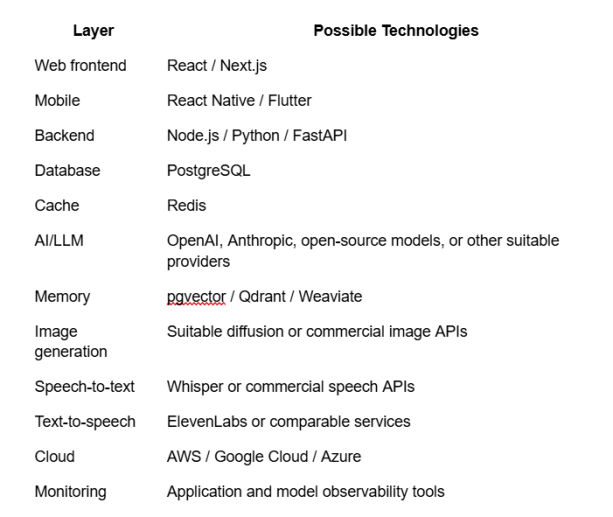
These are examples rather than mandatory choices. The best stack depends on expected traffic, latency requirements, privacy considerations, model availability, and development resources.
For example, an MVP with a few hundred users does not need the same infrastructure strategy as a platform expecting tens of thousands of simultaneous conversations.
How Much Does a Candy AI Clone Cost in 2027?
There is no single development price.
Recent published estimates vary widely. One 2026 estimate puts a basic AI companion MVP around $8,000–$20,000, while an advanced multimodal platform can reach $52,000–$150,000+.
Triple Minds currently publishes its own Candy AI-style development ranges from approximately $5,000–$12,000 for a white-label build, $16,000–$18,000 for a standard build, and higher ranges for differentiated, avatar, and enterprise implementations. These are provider-specific figures, not an industry-wide price.
A useful planning framework is:
Basic MVP
Approximate range: $8,000–$20,000
Potentially includes:
- User registration
- Character creation
- Text chat
- Basic personalization
- Basic memory
- Simple admin panel
Mid-Level Platform
Approximate range: $20,000–$50,000
May add:
- Advanced memory
- Image generation
- Voice
- Subscriptions
- Token systems
- Better moderation
- More sophisticated character management
- Analytics
Advanced Platform
$50,000–$150,000+
Could include:
- Multimodal interactions
- Advanced image/video generation
- Voice calls
- Complex agent workflows
- Custom AI models
- Advanced moderation
- High-scale infrastructure
- Extensive personalization
These should be treated as planning ranges rather than quotations. Actual cost depends heavily on scope and the development team.
What Actually Drives the Development Budget?
The biggest cost mistake is looking only at the initial development quote.
An AI companion platform has ongoing costs.
Every conversation can consume model resources. Images require additional inference. Voice adds speech processing. Video can be significantly more expensive.
Other recurring expenses can include:
- Cloud hosting
- AI API usage
- GPU infrastructure
- Database storage
- Content moderation
- Payment processing
- Customer support
- Monitoring
- Security
- Maintenance
One recent industry estimate places ongoing costs for AI companion platforms anywhere from roughly $1,400 to $15,000+ per month, depending heavily on usage and infrastructure.
The important lesson is simple:
Build cost determines whether you can launch. Operating cost determines whether you can keep the product running profitably.
The Biggest Challenges
Building a convincing AI companion is not as straightforward as connecting a chatbot API.
Keeping Personality Consistent
Users notice inconsistencies quickly.
If a character claims to love hiking in one conversation and later says they hate being outdoors, the illusion breaks.
Character instructions, conversation context, memory, and model behavior all need to work together.
Managing AI Memory
More memory does not automatically mean better memory.
The system needs to determine:
- What should be remembered?
- For how long?
- What should be forgotten?
- What information should never be stored?
- How should conflicting memories be handled?
Poor memory design can produce awkward or inaccurate responses.
Controlling AI Costs
An active user can generate a surprising amount of inference.
Long conversations consume more context. Image generation costs more than ordinary text. Voice and video introduce additional processing.
Usage limits, caching, model routing, and efficient context management can therefore become important parts of the business model.
Content Moderation and Safety
This becomes particularly important if the platform permits adult or otherwise sensitive interactions.
A responsible product needs appropriate safeguards around age restrictions, user reporting, prohibited content, privacy, and abuse prevention.
Moderation should be considered during architecture planning rather than added after launch.
Payments
AI companion platforms can face additional payment considerations depending on the type of content they support.
Payment providers have different rules regarding prohibited or restricted content, so payment infrastructure should be researched before development begins.
Scalability
A platform can work perfectly with 500 users and struggle when thousands arrive simultaneously.
The architecture needs to account for:
- Concurrent conversations
- Database load
- Queue management
- AI API limits
- GPU availability
- Image generation queues
- Storage
- Monitoring
Scaling should be planned progressively instead of paying for enterprise infrastructure before there is demand.
White-Label or Custom Development?
This is one of the biggest decisions before starting a Candy AI-style product.
White-Label Approach
A white-label solution can provide an existing foundation that is customized with a company's branding and selected features.
The main advantage is speed.
It can make sense when the objective is to test the market without spending months building every component from zero.
Custom Development
Custom development takes longer but provides greater control over:
- Product architecture
- User experience
- AI models
- Character systems
- Monetization
- Integrations
- Data architecture
- Scalability
The choice depends on whether the priority is **speed to market or deeper product differentiation**.
A practical strategy can also combine the two: launch with a solid foundation, validate demand, and invest in custom features once user behavior shows what actually matters.
Where Triple Minds Fits
Triple Minds offers a Candy AI-style development solution covering areas such as AI character creation, conversational AI, image generation, audio interaction, story generation, memory, moderation, and administrative controls.
Its published offering also provides different development tiers, from a white-label solution through more customized and enterprise-oriented builds.
That makes the company relevant for founders who are evaluating whether to start with a white-label foundation or build a more differentiated AI companion platform.
However, the right choice should still depend on the project's requirements rather than simply choosing a provider because it offers a feature checklist.
Watch the Concept in Action
For readers who want a visual understanding of what a Candy AI-style platform can look like, this demo provides a useful reference:
Candy AI Clone Demo on YouTube
The important takeaway is that the visible interface is only the surface. Behind a seemingly simple chat screen are model integrations, character logic, memory, media generation, databases, moderation, payments, and infrastructure.
A Realistic Development Roadmap
Instead of trying to build everything simultaneously, a staged approach is usually easier to manage.
Phase 1: Product Definition
Decide:
- Target audience
- Character types
- Core interaction
- Monetization
- SFW/NSFW boundaries
- Web or mobile platform
- Required integrations
Phase 2: MVP
Start with:
- Authentication
- Character creation
- AI chat
- Basic memory
- User profiles
- Admin controls
- Basic payments
Phase 3: Differentiation
Once the basic product works, consider:
- Voice
- Image generation
- Story modes
- Advanced memory
- Character customization
- Personalized recommendations
Phase 4: Scale
Only after product-market signals become clearer should you prioritize:
- Advanced infrastructure
- Model optimization
- GPU scaling
- Advanced analytics
- More sophisticated AI agents
- International expansion
This approach reduces the risk of spending heavily on features users may not actually use.
What Makes a Candy AI Clone Worth Building?
The biggest mistake would be treating the project as a simple copy.
The market already has AI companion products. A new entrant needs a reason to exist.
That reason could be:
- A specific audience
- A distinctive character system
- Better personalization
- Stronger voice interaction
- A particular storytelling experience
- A different monetization model
- A niche community
- Better privacy controls
- A unique combination of AI and entertainment
The technology gets you into the market.
The product experience gives users a reason to stay.
Final Thoughts
Building a Candy AI clone in 2027 is no longer simply a matter of creating a chat interface and connecting an LLM.
The real project involves designing an entire AI companion ecosystem—from character creation and conversation to memory, media generation, moderation, payments, infrastructure, and ongoing AI costs.
For a small MVP, keeping the feature set focused can make development more manageable. For a larger platform, the budget needs to account for not only development but also inference, storage, moderation, support, and scaling.
The most realistic approach is therefore to start with the experience that matters most, validate whether users actually return to it, and then expand.
An AI companion may begin with a conversation, but building a sustainable product around that conversation requires considerably more engineering behind the scenes.



Share the News