

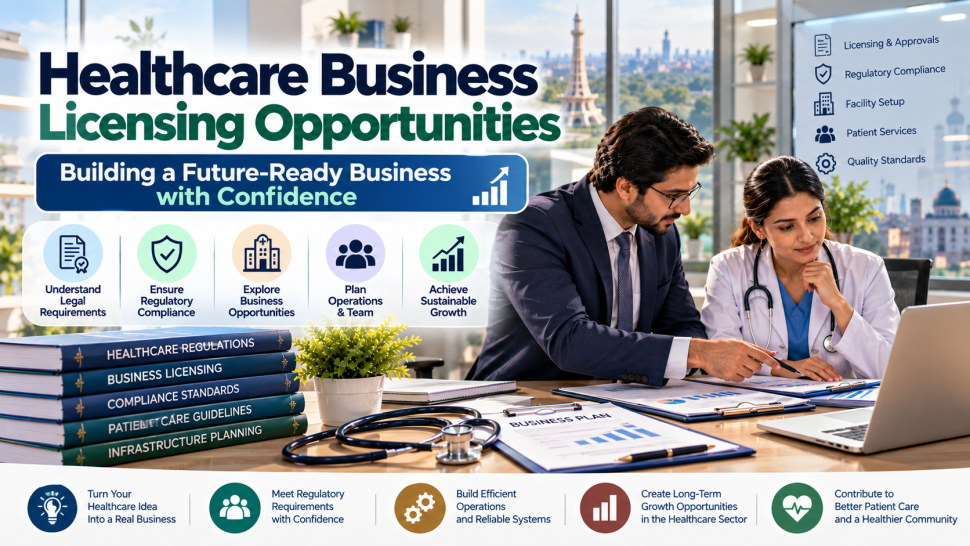

Healthcare business licensing opportunities are giving entrepreneurs new ways to establish services that respond to changing healthcare needs. As patients look for more convenient access to professional care, businesses have an opportunity to introduce thoughtful solutions that improve service delivery while meeting essential regulatory standards.
A successful healthcare venture begins long before its first customer arrives. Entrepreneurs need to understand the services they intend to provide, the people they want to serve, and the responsibilities involved in managing a regulated business.
The goal is not simply to enter a growing industry. It is to establish a dependable organization that combines professional expertise, responsible investment, and a clear commitment to service quality.
Exploring Healthcare Business Licensing Opportunities with a Long-Term Vision
Healthcare entrepreneurship requires a clear understanding of how commercial planning connects with professional responsibility.
Healthcare business licensing opportunities Unlike businesses that focus primarily on selling products, healthcare service providers must consider the direct impact of their operations on people seeking care and support.
This responsibility makes licensing an important part of business development.
Licensing requirements can influence facility selection, staffing decisions, equipment purchases, and everyday procedures. Understanding these expectations early helps entrepreneurs make practical decisions before committing significant resources.
A long-term vision should also consider how the business will respond to changing customer expectations, new technology, and future service requirements.
Entrepreneurs who approach licensing as part of their business strategy can prepare more effectively for sustainable operations.
Understanding the Customer Journey Before Choosing Services
One area that deserves greater attention during healthcare business planning is the customer journey.
People often interact with a healthcare service several times before and after an appointment. They may search for information, compare available options, contact support staff, arrange visits, and request follow-up assistance.
Each interaction influences how customers perceive the business.
Entrepreneurs can examine these experiences to identify services that are difficult to access or poorly coordinated.
For instance, an appointment management business might help simplify communication between patients and authorized healthcare professionals.
A rehabilitation service could focus on accessible scheduling and consistent professional support.
Understanding these practical needs helps business owners develop services with a clear purpose rather than introducing features that customers may not require.
Recognizing the Role of Regulatory Approval in Business Development
Healthcare businesses operate within legal frameworks intended to support patient protection and professional accountability.
The approvals required depend on the nature of the services, the business structure, and the applicable regulatory jurisdiction.
Some activities may require establishment registration, professional authorization, operating licenses, or technical assessments.
Entrepreneurs should determine which obligations apply before committing to a particular business model.
The licensing process may involve reviewing staffing credentials, facility arrangements, equipment suitability, and documented operating procedures.
Business owners should also recognize that general commercial registration does not necessarily authorize regulated healthcare activities.
Obtaining accurate information from relevant regulatory authorities can support better preparation and reduce avoidable difficulties during the approval process.
Designing Services That Are Practical and Accessible
An effective healthcare business should make services easier to access without compromising professional standards.
Accessibility involves more than selecting a convenient property. It also includes communication, appointment availability, understandable service information, and suitable arrangements for people with different needs.
Entrepreneurs should consider whether customers can easily contact the business, understand its services, and receive accurate guidance.
A well-designed service experience can reduce confusion and help employees manage daily operations more effectively.
Physical arrangements are equally important for businesses offering in-person services.
Entrances, waiting spaces, consultation areas, and essential equipment should be suitable for the activities being provided.
When accessibility is considered during the design stage, businesses can create more welcoming and organized environments.
Introducing Specialized Healthcare Services Responsibly
Specialized services may offer opportunities for entrepreneurs who want to address specific customer needs.
Potential areas include rehabilitation support, preventive health services, diagnostic coordination, and professional home care arrangements.
However, specialization requires careful consideration of professional expertise and operating responsibilities.
Entrepreneurs must determine whether suitably qualified individuals are available to deliver the proposed services.
They should also examine equipment requirements, operational costs, and the regulatory conditions associated with each activity.
A focused service offering may be easier to manage during the early stages of business development.
As customer demand becomes clearer, management can evaluate whether additional services would be appropriate.
Growth should reflect genuine needs and operational readiness rather than pressure to introduce numerous offerings immediately.
Developing Financial Plans That Support Business Continuity
Financial planning plays an essential role in maintaining a dependable healthcare business.
Entrepreneurs should prepare realistic estimates for property expenses, professional staffing, equipment, licensing costs, and administrative systems.
Ongoing obligations may include salaries, utilities, essential supplies, maintenance, and technology services.
Understanding these costs helps management establish suitable pricing and investment priorities.
It is also important to evaluate different revenue scenarios.
Customer demand may develop gradually, and unexpected expenses can affect financial performance during the early stages.
Maintaining appropriate working capital gives businesses greater flexibility when responding to operational challenges.
Financial stability supports consistent service delivery and reduces the pressure to make rushed decisions.
Exploring Smarter Healthcare Operations Through Technology
Technology continues to create new possibilities for managing healthcare businesses.
Digital scheduling platforms, secure document systems, electronic billing, and automated notifications can improve routine administrative processes.
In 2026, responsible artificial intelligence, information security, and effective digital workflows remain important considerations for technology-supported healthcare services.
Entrepreneurs may explore AI-assisted administrative tools for appointment coordination, information organization, and routine workflow support.
However, automated systems should operate with appropriate oversight, particularly when handling sensitive information.
Protecting patient records and controlling access to confidential data are essential responsibilities.
Businesses should evaluate technology according to its practical benefits rather than adopting complex systems simply because they are new.
A thoughtful digital strategy can improve efficiency while preserving the personal communication customers value.
Creating Clear Responsibilities Across the Business
Even a small healthcare enterprise can experience operational difficulties when responsibilities are not clearly defined.
Entrepreneurs should establish who manages regulatory documentation, staff scheduling, customer communication, equipment maintenance, and financial records.
Clinical activities must remain under the responsibility of appropriately qualified and authorized professionals.
Administrative teams should understand their role in supporting these services without exceeding their responsibilities.
Written procedures can help employees maintain consistency and respond appropriately when problems occur.
Regular communication between management and staff also supports better coordination.
An organized structure makes everyday operations easier to monitor and provides a foundation for introducing improvements as the business develops.
Building Strong Relationships Through Service Transparency
A healthcare business earns confidence by communicating clearly and delivering services consistently.
Customers should receive accurate information about available services, professional qualifications, appointment arrangements, and applicable charges.
Unclear descriptions or unrealistic promises can create misunderstandings and weaken confidence.
Entrepreneurs should encourage employees to communicate respectfully and respond to customer concerns professionally.
Feedback can also provide useful insights into how the business operates.
For example, recurring questions about appointment procedures may suggest that information needs to be presented more clearly.
Improving communication does not always require significant financial investment.
Simple changes to instructions, scheduling processes, and customer support can make services easier to understand.
Preparing for Change Through Regular Business Reviews
Long-term healthcare business development requires the ability to recognize when existing procedures need adjustment.
Entrepreneurs should periodically review financial performance, service demand, staffing arrangements, and operational standards.
These assessments can reveal whether resources are being used efficiently and whether customers are receiving a consistent experience.
Regulatory changes should also be monitored, particularly when businesses plan to introduce additional services.
Before expansion, management should consider whether existing systems can support increased responsibilities.
Sometimes improving current workflows provides greater value than opening additional facilities or introducing more services.
Continuous assessment encourages thoughtful decision-making and helps businesses adapt without compromising their essential responsibilities.
Conclusion
Healthcare business licensing opportunities allow entrepreneurs to explore meaningful business ideas while developing services built around professional accountability and customer needs.
Successful business development begins with understanding regulatory requirements, researching service demand, selecting suitable professionals, and preparing realistic financial plans.
Modern technology can strengthen operations when used responsibly, while clear communication and organized management contribute to a dependable customer experience.
Rather than pursuing rapid expansion, entrepreneurs should focus on creating services that remain practical, accessible, and financially sustainable.
A future-ready healthcare business is ultimately built through careful preparation, continuous learning, and a consistent commitment to responsible service delivery



Share the News